The Doorbell Surveillance State: A Technical and Statistical Analysis of Smart Doorbells, Law Enforcement Partnerships, and the 67 Million Daily Strangers at Your Door

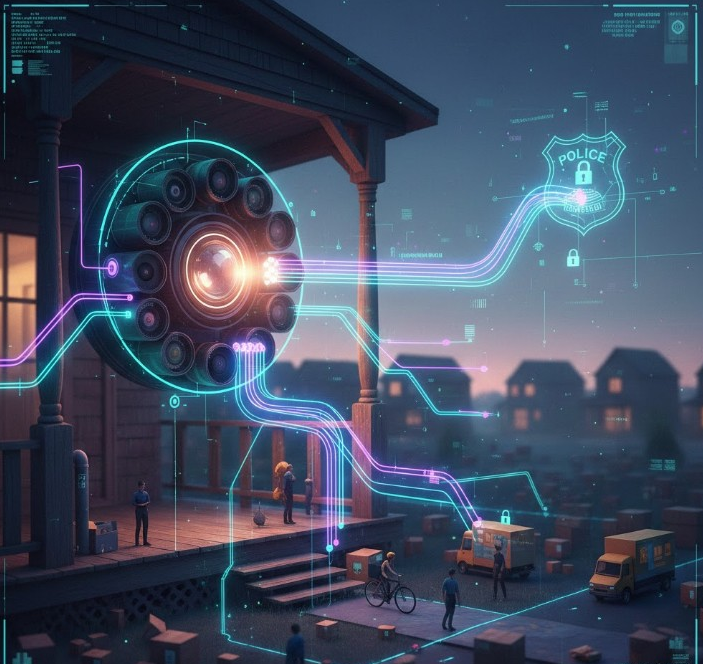
An estimated 60+ million packages arrive at American doorsteps every single day. Over a third of those homes now have a camera pointed at whoever drops them off. Here's what the numbers actually tell us about the largest distributed surveillance network ever built — and who really controls the footage.
Executive Summary
The convergence of three accelerating trends — mass adoption of smart doorbell cameras, explosive growth in home delivery volume, and deepening partnerships between device manufacturers and law enforcement — has created the largest privately-owned, publicly-accessible surveillance infrastructure in history. This analysis compiles current market data, law enforcement cooperation statistics, delivery volume figures, and gig workforce demographics to quantify what this ecosystem actually looks like in 2026 — and what it means for the millions of workers, visitors, and bystanders captured on camera every day without their knowledge or consent.
Part 1: The Installed Base — How Many Doorbell Cameras Are Actually Out There
Global Market Scale
The smart doorbell camera market has grown from a niche product category to a dominant consumer electronics segment in under a decade. Ring shipped the first consumer video doorbell in 2014. By 2026, the numbers tell a very different story.
The U.S. smart home security camera market is valued at approximately $3.9 billion in 2026, with smart video doorbell cameras commanding a 45% share of the total camera-type segment. The global smart doorbell market exceeded $1.28 billion in 2024 and is projected to reach $6.9 billion by 2033, expanding at a compound annual growth rate (CAGR) of 20.6%.
Global shipments of smart doorbell cameras surpassed 15.2 million units in 2023, up from 11.4 million in 2021 — a 33% increase in just two years. North America alone accounts for 40% of the global installed base.
 Secure IoT Office
U.S. Household Penetration
The penetration numbers are striking. As of 2024-2025, smart doorbells are in more than one-third of American homes, making them the most common package-protection device in the country. In suburban communities specifically, roughly 63% of households have adopted video doorbells. More than 8 million active doorbell camera units were operational across American households by the end of 2023, and the installed base has continued growing.
By 2025, approximately 70% of new single-family homes are being built with smart doorbell compatibility, embedding the infrastructure for surveillance directly into the housing stock.
In urban areas, over 60% of smart home setups now include a video doorbell. Approximately 74% of smart doorbell installations are integrated with mobile apps for remote monitoring and two-way communication.
Who Owns the Market
The market is dominated by a handful of companies whose law enforcement relationships warrant close examination:
- Amazon Ring: Commands approximately 40% of all video doorbells in U.S. households. Ring accounts for an estimated 12% of all video doorbells worldwide. Of the 3.5 million video doorbells sold by the top five brands in recent tracking periods, 40% were Ring.
- Google Nest: Holds approximately 24% of the U.S. video doorbell market.
- Other significant players: Arlo Technologies, ADT, SimpliSafe, Vivint, Eufy, and SkyBell round out the competitive landscape, with more than 40 established players currently competing for market share.
The combined Ring + Nest share of approximately 64% of U.S. video doorbells means that nearly two-thirds of all doorbell camera footage in America flows through servers controlled by Amazon or Google — two companies with documented, extensive law enforcement cooperation programs.
 Secure IoT House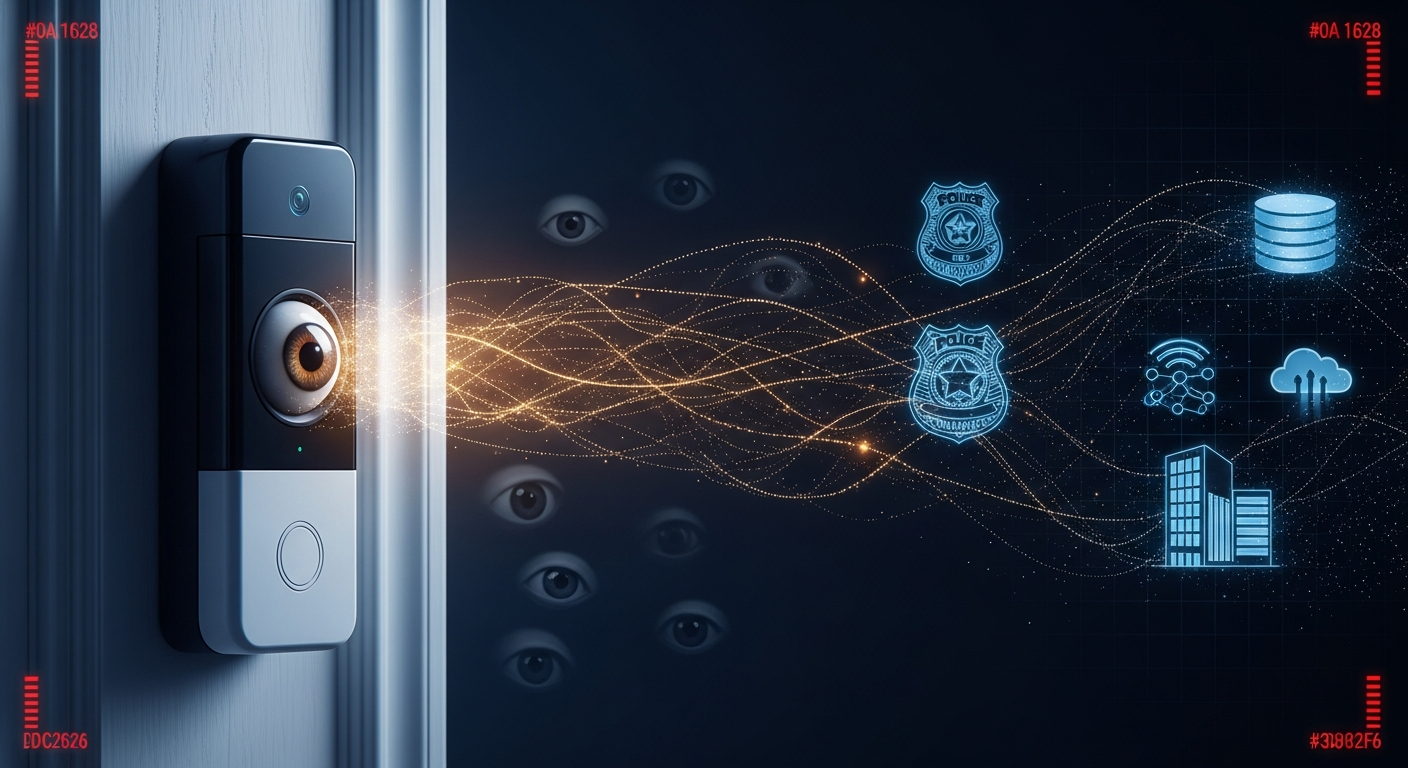
Part 2: The Delivery Explosion — 67 Million Strangers at America's Doors Every Day
The Scale of Daily Deliveries
The sheer volume of packages arriving at American homes has reached a scale that would have been unimaginable a decade ago. In 2025, an estimated 67 million parcels are shipped daily across the United States. That volume breaks down across the major carriers as follows:
| Carrier | Daily U.S. Package Volume (2024-2025) | Market Share |
|---|---|---|
| USPS | 23.5 million | 30.8% |
| Amazon Logistics | 17.3–24 million | 28.2% |
| UPS | 12.9–17.4 million | 21.0% |
| FedEx | 10.1–14.8 million | 16.5% |
| Other carriers | ~2.1 million | 3.5% |
The total U.S. parcel volume reached approximately 23.4 billion packages in 2025, with projections indicating 24.6 billion in 2026. The average American household received 167 packages in 2024. That means a delivery person — often a different one each time — is approaching the average American front door roughly every 2.2 days.
From 2018 to 2024, Amazon Logistics' package volume alone increased by 688%. Amazon DSP (Delivery Service Partner) drivers make an average of 180 stops per day, delivering 250-300 packages per shift. To stay on schedule, each driver must complete one stop every 2 minutes and 15 seconds — a pace that leaves essentially zero time for anything beyond dropping the package and moving on.
The Gig Economy Layer
But packages are only part of the picture. Food delivery, grocery delivery, pharmacy delivery, and other gig-platform services are layering additional foot traffic onto American doorsteps at a rapidly increasing rate.
The gig economy workforce has ballooned. As of recent data, more than 23 million Americans have earned money through an online platform in the past 12 months. Approximately 36% of the U.S. workforce is now involved in the gig economy in some capacity. Specific platform numbers include:
- DoorDash: More than 2 million monthly active Dashers; over 13 million total Dashers have used the platform since launch. DoorDash commands 67% of the U.S. food delivery market.
- Uber: 5.4 million active "earners" (drivers and delivery workers) as of Q4 2022, with the number continuing to grow.
- Instacart, Shipt, Amazon Flex, Grubhub, and others: Collectively employ millions more.
The critical detail: 72% of gig workers combine platform work with other employment. Most are part-time — 90% of DoorDash workers work fewer than 10 hours per week, and 71% of Uber earners average fewer than 20 hours weekly. This means the pool of individuals showing up at doorsteps is not a stable, identifiable workforce — it's a rotating cast of millions of people, many of whom are working sporadically across multiple platforms.
Background Check Realities
Gig delivery platforms require some form of background screening, but the standards vary dramatically from those applied to, say, postal carriers or UPS employees (who undergo federal background checks and are unionized, career employees). Uber's own signup process describes it simply as "complete a background screening."
The distinction matters. A USPS letter carrier has been through a federal background investigation, holds a stable government position, and services the same routes consistently. A DoorDash driver completing their third-ever delivery is an entirely different proposition from a security and accountability standpoint — yet both are being recorded by the same doorbell cameras, and both sets of footage flow into the same cloud infrastructure accessible by law enforcement.
What This Means in Surveillance Terms
Combining delivery and gig economy traffic, a conservative estimate suggests that American doorsteps see well over 100 million individual delivery or service visits per day when accounting for packages, food delivery, grocery delivery, and other platform-based services. Each visit to a doorbell-camera-equipped home generates footage that is transmitted to cloud servers — footage that captures the worker's face, body type, gait, clothing, vehicle, license plate, and precise timestamp.
For delivery workers, this means they are being surveilled at a scale that no other workforce in history has experienced. A full-time Amazon DSP driver making 180 stops per day is potentially recorded by 60+ doorbell cameras daily (assuming the one-third household penetration rate). Over a five-day work week, that's 300+ separate camera recordings of a single worker. Over a year, we're talking about 15,000+ individual surveillance captures per driver — none of which they consented to, and all of which are potentially accessible to law enforcement.
Part 3: Law Enforcement Partnerships — The Numbers
Amazon Ring: The Largest Private-Public Surveillance Network
Ring's relationship with law enforcement is the most extensively documented and, by the numbers, the most expansive.
Scale of partnerships:
- Ring has active partnerships with over 2,678 local law enforcement agencies across every U.S. state, plus 622 fire departments and 113 local government agencies.
- This represents growth from 405 police department partnerships disclosed in August 2019, to 1,800+ by mid-2021, to 2,161 confirmed in a 2022 letter to Senator Ed Markey, to the current figure exceeding 2,600 — a more than sixfold increase in under five years.
- Ring's previous "Request for Assistance" tool was used by at least 2,500 police agencies before it was removed in January 2024. It was re-introduced in 2025 through a partnership with Axon (the manufacturer of TASER devices and police body cameras), and further expanded through a deal with Flock Safety, a law enforcement technology company ranked #7 on the 2025 CNBC Disruptor 50 list.
Volume of footage requests:
- In the first quarter of 2020 alone, police requested Ring footage over 5,000 times through direct user requests. Over 20,000 video requests were made by police through Ring partnerships in 2020 overall.
- In 2022, Amazon confirmed it had provided police with Ring footage 11 times without user consent or a warrant, citing "emergency" provisions involving "imminent danger of death or serious physical injury." This disclosure came in response to questioning from Senator Ed Markey.
- Ring's emergency exception policy allows law enforcement to request footage directly from Amazon, bypassing the device owner entirely, with Amazon making a unilateral "good-faith determination" about whether the situation qualifies.
- Ring does not disclose the total number of users whose footage has been provided to law enforcement through legal orders (warrants, subpoenas, court orders), making it an outlier among major tech companies in this regard.
The Flock Safety integration (2025): Ring's newest law enforcement integration, through Flock Safety, enables officers to directly request video evidence from Ring cameras via Flock's digital evidence management platform. Flock Safety currently supports law enforcement in making close to one million arrests per year, and its CEO has stated this partnership "will help that number go up." The integration is being offered free to every Flock Safety law enforcement customer.
 Secure IoT House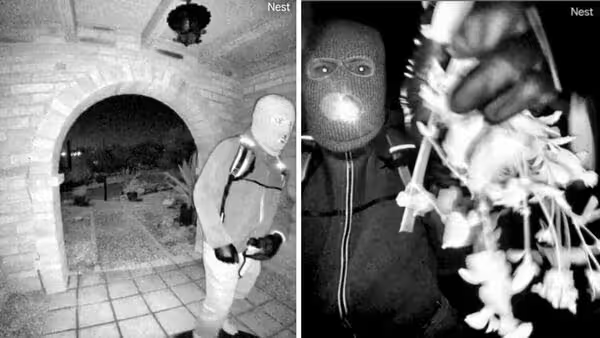
Google Nest: Growing Transparency Gaps
Google Nest's law enforcement cooperation is less granular in its public reporting but no less significant.
- Nest data requests were folded into Google's broader Transparency Report starting in 2020. Prior to that, Nest published its own transparency report showing law enforcement data requests increasing from approximately 50 in 2015 to about 130 in 2017 — and climbing. Over a three-year period through 2017, law enforcement requested Nest data at least 300 times.
- Google's overall transparency report shows the company receives tens of thousands of government data requests globally each year across all its services. The exact number attributable specifically to Nest camera footage is not broken out.
- Google's Nest transparency report states: "If a US government agency presented us with a search warrant to investigate a crime they think was captured on a Nest Cam, we wouldn't just hand over user data. We'd analyze the request to be sure the warrant wasn't overly broad." However, the Nancy Guthrie case demonstrated that Google engineers can and will work directly with the FBI to excavate footage from "backend systems" — including footage that should have been deleted and wasn't even supposed to exist without a subscription.
- Law enforcement seeking Google Nest data must submit requests through Google's Law Enforcement Request System (LERS), and responses are typically provided "in just a few days," according to Josh Brunty, a professor of cyber forensics at Marshall University.
The Broader Ecosystem
Other camera companies maintain their own law enforcement relationships:
- Arlo, ADT, and SimpliSafe: Have publicly stated they only share video in response to legally binding orders or with user consent — declining to share even in life-threatening emergencies without a court order.
- Eufy: Has marketed itself on local storage as a privacy alternative, though it faced controversy over undisclosed cloud uploads.
- Roku: Now offers smart home cameras and works with law enforcement on video recovery for investigations.
The practical reality, as Pima County Sheriff Chris Nanos stated during the Guthrie investigation: "I can't even tell you how many different corporate America, Google, Apple, Meta, all these companies have said, 'Whatever you need, Sheriff, they're there.'"
Part 4: The Privacy Calculus — What the Data Adds Up To
The Surveillance Math
Let's put these numbers together:
- ~135 million U.S. households (Census Bureau estimate)
- ~34%+ equipped with video doorbells = approximately 46 million doorbell cameras
- 167 average packages per household per year + food/grocery/gig deliveries = estimated 200+ doorstep visits annually per household
- 46 million cameras × 200 annual visits = approximately 9.2 billion individual doorbell camera captures per year from delivery and service visits alone
That figure doesn't include neighbors walking past, mail carriers, solicitors, children playing, or anyone else who happens to trigger a motion sensor. The actual number of individual captures is likely multiples higher.
Those billions of recordings flow primarily to Amazon (Ring) and Google (Nest) servers — where they are retained for periods ranging from three hours (Nest without subscription) to 60 days (Nest Advanced), and where they can be — and routinely are — accessed by law enforcement through formal requests, warrants, and in some cases, emergency exceptions that bypass the homeowner entirely.
Package Theft: The Driving Justification
The consumer rationale for doorbell cameras is overwhelmingly package security. The data supports the concern:
- Over 104 million packages were stolen from American porches in 2024-2025, down from 120 million in 2023 — but still representing losses of approximately $37 billion.
- 41% of Americans have been a porch piracy victim at some point.
- 52% of Americans worry about package theft.
- 87% worry more during the holiday season.
- 210 million packages were stolen in 2023 by some estimates.
But the effectiveness data tells a more nuanced story:
- 38% of consumers do not believe doorbell cameras effectively deter porch piracy.
- Among package theft victims, 22% already had a doorbell camera when the theft occurred.
- There is approximately a 1-in-17 chance (5.9%) that law enforcement will catch a reported package thief.
- Research using doorbell camera footage found that these devices "do not significantly deter package theft" — visibility from the roadway and brand recognition on packages are more predictive of theft than camera presence.
In other words: tens of millions of Americans are feeding billions of recordings into corporate cloud infrastructure accessible by law enforcement, largely to prevent a crime that the cameras demonstrably fail to prevent in a significant percentage of cases.
The Worker Surveillance Dimension
The privacy conversation around doorbell cameras almost exclusively focuses on the homeowner. But the people captured most frequently — and with the least agency in the matter — are the workers.
An estimated 23+ million Americans earn money through gig platforms. These workers, along with traditional carrier employees, are captured on doorbell cameras at extraordinary rates. A gig delivery driver has no ability to:
- Consent to being recorded
- Know what is done with the recordings
- Request deletion of footage from homeowner or cloud systems
- Know whether their footage has been shared with law enforcement
- Challenge inaccurate identification or mistaken association with criminal activity
As previously discussed in our analysis of always-on home devices (Your Smart Doorbell Is Watching More Than You Think), the privacy implications extend far beyond what most consumers consider when installing a $150 device on their front door.
The implications are particularly acute given the demographics of gig workers: according to multiple studies, gig delivery workers are disproportionately recent immigrants, people of color, and individuals in economically precarious situations. The EFF has documented how Ring's partnership model and the Neighbors app create mechanisms where users "make snap judgements about who does, and who does not, belong in their neighborhood — and (sometimes dangerously) summon police to confront them."
Amazon's own data reveals that four Ring employees improperly accessed and used Ring video data — a reminder that the threat model includes not just government surveillance but also insider access by company employees.
Part 5: The Legal and Regulatory Landscape
Current Legal Framework
The legal protections governing doorbell camera footage are a patchwork of federal and state laws that were largely written before these devices existed:
- Stored Communications Act: Generally requires a warrant for law enforcement to obtain stored electronic communications, including cloud video. But "emergency" exceptions allow companies to voluntarily share data without legal process.
- Fourth Amendment: Protects against unreasonable searches and seizures. The Supreme Court has ruled warrants are needed for GPS tracking and cell location data, but hasn't specifically addressed always-on doorbell cameras pointed at public spaces.
- State wiretapping laws: Some states require two-party consent for audio recording, which may apply to doorbell cameras with two-way audio capturing conversations of visitors who haven't consented.
- Illinois BIPA: Requires explicit consent before capturing biometric data like facial scans. Google Nest's privacy statement acknowledges this requirement obliquely without naming the law.
What's Missing
There is currently no federal legislation that:
- Limits how long companies can retain doorbell camera footage
- Requires companies to disclose when footage is shared with law enforcement
- Gives recorded individuals (delivery workers, visitors, passersby) any rights over footage of themselves
- Mandates true deletion of footage (as opposed to the "soft delete" model exposed by the Guthrie case)
- Restricts the use of facial recognition on doorbell camera footage
- Requires transparency about AI analysis performed on stored footage
Organizations including the Electronic Frontier Foundation and the ACLU have been pushing for tighter data minimization requirements and explicit retention limits, but no comprehensive legislation has materialized.
Conclusions
The data paints a clear picture: we have built a surveillance infrastructure of unprecedented scale, owned by private companies, funded by consumer purchases, justified primarily by package theft anxiety, and made accessible to law enforcement through an expanding web of formal partnerships, legal demands, and emergency exceptions.
The key statistics bear repeating:
- 46+ million doorbell cameras in American homes
- 9.2+ billion delivery-related camera captures per year
- 2,600+ police departments partnered with Ring alone
- 67 million daily package deliveries plus millions more gig deliveries
- 23+ million gig workers routinely recorded without consent
- 104 million packages stolen annually despite the cameras
- 64% of all doorbell footage flowing to just two companies (Amazon and Google)
The question is no longer whether a distributed surveillance network exists. It does. The question is whether the current regulatory framework, consumer awareness, and corporate accountability structures are remotely adequate for the scale of what's been built.
Based on the numbers: they are not.
This article is part of our ongoing coverage of smart home privacy, IoT security, and the surveillance implications of connected devices at SecureIoT.house. For more on the privacy implications of doorbell cameras, read our previous analysis: Your Smart Doorbell Is Watching More Than You Think: The Privacy Nightmare of Always-On Home Devices. For our analysis of the Nancy Guthrie case and what "deleted" really means in the cloud, see: "Deleted" Doesn't Mean Gone: The Nancy Guthrie Case Just Exposed the Uncomfortable Truth About Your Smart Camera.
Sources & References
Market data sourced from Future Market Insights, Market Growth Reports, Straits Research, Grand View Research, Industry Research, and Verified Market Reports. Law enforcement partnership data from EFF, Tom's Guide, CNBC, Vice/Motherboard, TechCrunch, and Ring's own transparency reports. Delivery volume data from Capital One Shopping Research, ShipMatrix, Red Stag Fulfillment, and SellersCommerce. Gig economy statistics from Pew Research Center, Human Rights Watch, Economic Policy Institute, Goldman Sachs, and WTTW Chicago. Package theft data from Security.org, SafeWise, ValuePenguin, and Chamber of Commerce. Privacy analysis informed by the Brennan Center for Justice, Surveillance Technology Oversight Project, and Consumer Reports.