Smart Sleep Mask Security Nightmare: How Strangers Can Watch Your Brainwaves—And Shock You While You Sleep
A crowdfunded IoT device exposes the most intimate data imaginable, revealing everything wrong with consumer neurotechnology security.
The Two-Sentence Horror Story
Imagine drifting off to sleep wearing a high-tech mask that monitors your brain activity to optimize your rest. Now imagine that a stranger—anyone, anywhere in the world—can watch your brainwaves in real-time, know exactly when you're dreaming, and if they felt like it, send electrical pulses directly into your face while you're unconscious.
This isn't a Black Mirror pitch. It's a real product that real people are wearing to bed right now.
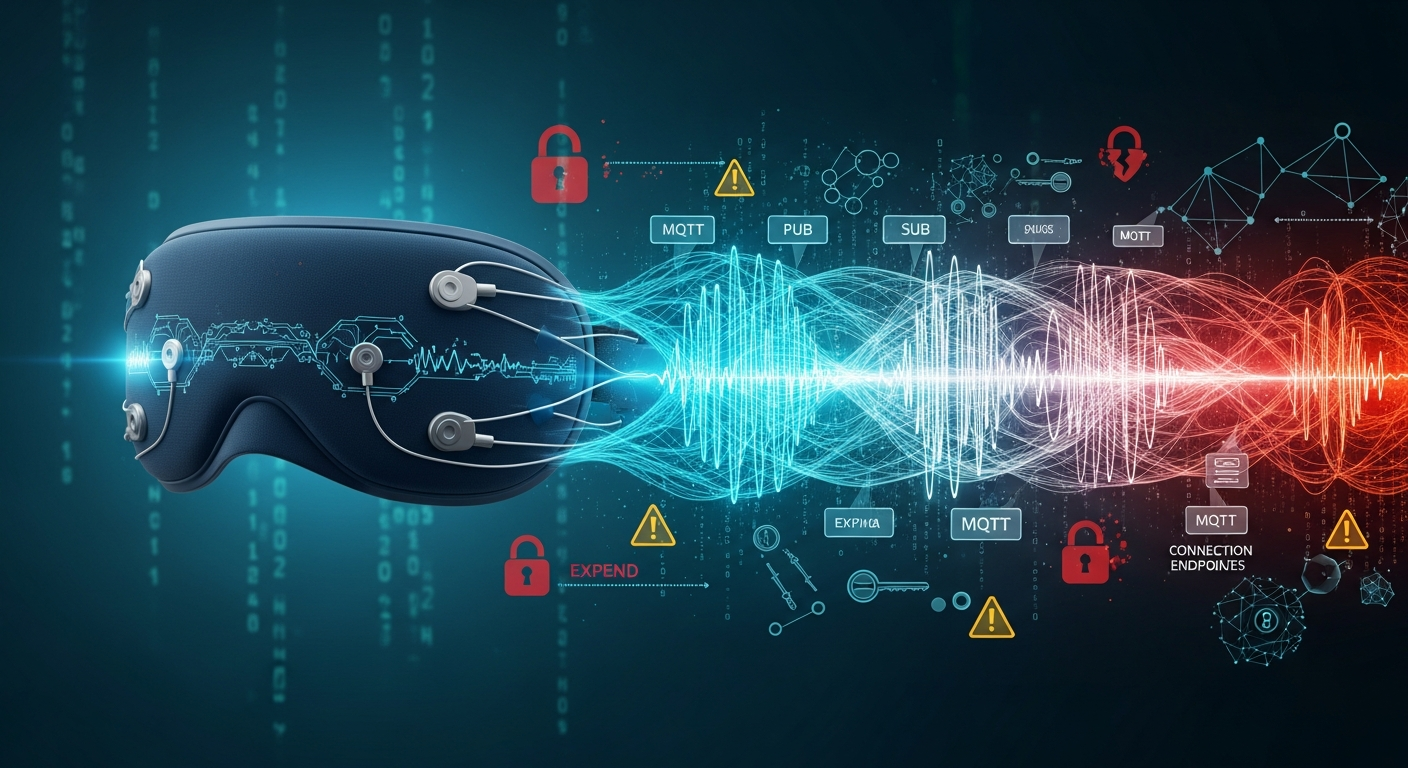
On February 12, 2026, security researcher Aimilios published a devastating exposé of an unnamed smart sleep mask sold through Kickstarter. Using an AI assistant over a 30-minute session, he discovered that the device broadcasts live EEG brainwave data to an open internet server using shared credentials that anyone can access. Worse still, that same open channel accepts commands—including instructions to deliver electrical stimulation to the user's face.
The story hit #1 on Hacker News by February 14th, racking up nearly 400 upvotes and 179 comments from a community that has seen its share of IoT security disasters. The consensus? This might be the most intimate privacy violation in the history of consumer technology.
Let's unpack exactly what went wrong, why it matters far more than most IoT breaches, and what you need to know before strapping any "smart" device to your body.
What We're Dealing With: A Sophisticated Neurotech Device
The device in question isn't your basic eye mask with Bluetooth speakers. It's a legitimate piece of neurotechnology packed with capabilities that would have required a medical lab just a decade ago:
The Hardware
- 8-channel EEG sensors sampling at 250Hz—the same technology used in clinical sleep studies
- Electrical Muscle Stimulation (EMS) electrodes positioned around the eyes
- Vibration motors for haptic feedback
- Heating elements for thermal therapy
- Built-in audio playback pulling music from cloud storage
- Respiration sensor to track breathing patterns
- 3-axis accelerometer and gyroscope for motion tracking
- Wi-Fi and Bluetooth Low Energy (BLE) for connectivity
This is a serious piece of kit. The 8-channel EEG alone represents real neuroscience capability—enough to accurately classify sleep stages, detect REM cycles (when you're dreaming), monitor for signs of neurological conditions, and observe real-time changes in your mental state.
The EMS feature is designed to provide gentle stimulation that the manufacturer claims can influence lucid dreaming or improve sleep quality. In medical contexts, similar technology is used for everything from pain management to physical therapy. In the hands of an attacker with full command access? That's a question no one should ever have to ask.
How It Works (When Working Correctly)
The intended operation is straightforward:
- You wear the mask to bed
- The device connects to your phone via Bluetooth
- Throughout the night, it monitors your EEG, respiration, and movement
- The companion app (Flutter-based, for Android) tracks your sleep stages
- Based on your brain activity, the device may deliver timed stimulation to enhance sleep quality
- In the morning, you wake up with detailed sleep analytics
It's a compelling value proposition. Who wouldn't want objective data about their sleep quality and intelligent interventions to improve it?
The problem is what happens between steps 2 and 3—where your brain data travels before it reaches your phone.
The Discovery: AI vs. AI in 30 Minutes
Security researcher Aimilios didn't set out to expose a massive privacy breach. He just wanted to use his sleep mask without dealing with a buggy app.
"The official app was unreliable," he explained in his blog post. Rather than give up on the device, he decided to reverse-engineer the communication protocol so he could build his own client. His tool of choice? Claude, Anthropic's AI assistant, running in an autonomous mode.
What followed was a masterclass in AI-assisted security research—and a cautionary tale about AI-assisted software development.
The 30-Minute Breakdown
Here's what Claude accomplished in half an hour:
Step 1: Bluetooth Reconnaissance
Claude scanned the local Bluetooth environment, identifying the sleep mask among 35 nearby devices. IoT devices typically broadcast identifiable service UUIDs, making them easy to spot.
Step 2: APK Extraction and Decompilation
Using jadx, a standard Android reverse-engineering tool, Claude unpacked the companion app's APK file, exposing the compiled code and resources inside.
Step 3: String Extraction
Running strings on the Flutter binary (libapp.so) revealed hardcoded text embedded in the app—including something that should never be there: MQTT broker credentials.
Step 4: The Smoking Gun
Buried in the binary were hardcoded username and password strings for an MQTT broker. MQTT (Message Queuing Telemetry Transport) is a standard pub/sub messaging protocol used throughout the IoT industry. Devices publish sensor data to topics on a broker; apps subscribe to those topics to receive the data.
The critical failure: every single copy of the app ships with identical credentials.
Step 5: Protocol Analysis
Claude used "blutter," a specialized tool for decompiling Flutter's Dart snapshots, to reconstruct the app's command protocol. This revealed exactly how the app communicates with the device—including all 15 supported command functions.
Step 6: Command Mapping
The final step was documenting every command the device accepts, including:
buildVibratorControlCommand: 0x62
buildHeatingControlCommand: 0x63
buildStimulationControlCommand: 0x64  ← Electrical impulses
buildMusicControlCommand: 0x61
Game over. In 30 minutes, an AI had completely reverse-engineered a neurotech device and discovered that anyone in the world could access any user's brain data and send arbitrary commands.
The Poetic Irony
Here's where the story gets philosophically interesting. Hacker News commenters immediately noticed something remarkable: the vulnerability was almost certainly created by AI-assisted development, and it was discovered by AI-assisted security research.
As one commenter put it: "Plot twist: the server giving worldwide access to send people electrical stimulation was also implemented by Claude."
We're living in an era of "vibe coding"—where developers increasingly rely on large language models to generate boilerplate code without necessarily understanding every line. A developer might ask an AI to "set up MQTT communication for my IoT device," receive perfectly functional code that uses hardcoded credentials, and ship it without recognizing the catastrophic security implications.
The AI didn't know better. The developer didn't catch it. QA didn't test for it. And now strangers can read your brain.
This is the double-edged sword of AI in software development. It accelerates development dramatically—but when developers don't understand their own code, security assumptions go unverified. The same AI that can help build insecure systems can also help expose them.
The question is which happens first.
The Vulnerability: A Complete Security Collapse
Let's get specific about what's actually broken here, because this isn't a single bug. It's a cascade of security failures, any one of which would be serious, but combined create a perfect storm of exposure.
Failure #1: Hardcoded Shared Credentials
Every installation of the app contains the same MQTT username and password. This isn't just "bad practice"—it's security nihilism.
Here's what shared credentials mean in practice:
- Anyone who downloads the app can extract the credentials
- Those credentials grant access to the central broker
- Every user's data is on that broker
- There is no concept of "per-user authentication"
This is equivalent to an apartment building where every tenant uses the same key—and that key is taped to the front door with a sign saying "KEY HERE."
Failure #2: No Per-Device Authentication
A properly designed IoT system generates unique credentials for each device during the manufacturing or registration process. Each device has its own certificate or API key that only allows it to access its own data.
This mask? Every device connects as the same user. The broker can't tell Device A from Device B. They're all just "SleepMaskUser" (or whatever the hardcoded credential is).
Failure #3: No Access Control Lists
MQTT brokers support Access Control Lists (ACLs) that restrict which clients can subscribe to which topics. A client representing User Alice should only access topics like alice/sleep-data/*, not bob/sleep-data/*.
This broker has no such restrictions. Once connected, a client can subscribe to everything. Every user's EEG data. Every device's status. The whole namespace is wide open.
Failure #4: No Transport Encryption
Modern MQTT implementations support TLS encryption, ensuring that data in transit can't be intercepted by network observers. Even if access controls failed, encrypted transport would provide a layer of defense.
This implementation? Unencrypted MQTT over port 1883. The data isn't even protected from a passive eavesdropper on the same network, let alone an attacker connected to the broker.
Failure #5: No Command Authentication
Here's where it goes from "privacy violation" to "physical safety hazard."
The broker doesn't just accept subscriptions to data topics—it accepts publish commands to control topics. And those commands are processed by devices with zero verification of who sent them.
An attacker who connects to the broker can publish to any device's command topic:
buildVibratorControlCommand: 0x62  → Activate vibration motor
buildHeatingControlCommand: 0x63   → Turn on heating elements
buildStimulationControlCommand: 0x64 → Send electrical impulses
buildMusicControlCommand: 0x61     → Play audio
There's no signature. No challenge-response. No verification that the command originated from the legitimate user's phone. If you can connect to the broker, you can shock sleeping strangers.
The Complete Packet Structure
Aimilios documented the protocol format:
[0xAA] [0x01] [CMD] [payload...] [0xBB] [0x0D] [0x0A]
  ^      ^      ^                   ^      ^     ^
Start  Dir   Command byte          End   CR    LF
Simple. Predictable. Completely lacking in security primitives. No nonces, no timestamps, no HMACs, no encryption. Just raw command bytes wrapped in framing characters.
What the Researcher Observed
When Aimilios connected to the broker with the extracted credentials, he received real-time data from approximately 25 active devices:
| Data Stream | Content | Sensitivity |
|---|---|---|
| Live EEG | Base64-encoded 16-bit brainwave signals at 250Hz | Extreme |
| Sleep State | Computed REM/N3/light sleep stages | High |
| Respiration | Breathing patterns and rate | Moderate |
| Device Telemetry | Battery, firmware, serial numbers | Moderate |
| Motion Data | Accelerometer and gyroscope readings | Low |
Some of the devices weren't even sleep masks—the same broker hosts air quality monitors (temperature, humidity, CO2) and presence/radar sensors from the same manufacturer.
The ecosystem appears to be an entire product line built on the same fundamentally broken security architecture.
Why Brainwave Data Is Different: The Most Intimate Exposure Imaginable
Here at SecureIoT.House, we've covered smart door locks that could be opened remotely, cameras that broadcast to the internet, and baby monitors hijacked by trolls. Those are all serious privacy violations.
This is worse. By an order of magnitude.
Your Brain Patterns Are Irreplaceable Biometrics
When your password leaks, you change it. When your credit card number leaks, you get a new card. When your fingerprint leaks? That's more serious—you can't grow new fingers—but fingerprints are relatively limited in what they reveal about you.
Your brainwave patterns are different. They are:
- Uniquely Identifying – EEG patterns are increasingly recognized as biometric identifiers. Like fingerprints, but more complex. Once cataloged, your brainwave signature could theoretically be used to identify you across different systems.
- Permanently Fixed – You cannot change your brainwave patterns. A compromised neural signature is compromised forever. There's no "reset password" for your brain.
- Deeply Revelatory – This is the crucial difference. Your brainwave patterns don't just identify you. They reveal your inner state.
What EEG Data Can Expose
Published neuroscience research demonstrates that EEG analysis can detect:
Sleep Architecture
- REM sleep (when you're dreaming) vs. deep sleep (N3) vs. light sleep
- Sleep disorders like apnea, insomnia, or restless leg syndrome
- Sleep quality metrics and disturbances
Emotional States
- Stress, anxiety, and relaxation levels
- Emotional responses to stimuli
- Mood patterns over time
Cognitive Function
- Attention and focus levels
- Cognitive load and mental fatigue
- Working memory engagement
- Signs of neurological conditions (early Alzheimer's, epilepsy, ADHD)
Responses to Stimuli
- Reactions to images, sounds, or ideas
- Marketing research ("does this ad engage you?")
- Political content response
- Deception detection attempts
Sleep-Specific Insights
- Dream activity periods
- Memory consolidation phases
- Subconscious processing patterns
Let's be explicit about what this means in the context of the vulnerability: a stranger on the internet can observe when you're dreaming.
They can watch your brain transition through sleep stages. They can see if you're having a restless night or sleeping peacefully. They can correlate your neural activity with external factors—maybe they also compromised your smart home and know exactly what sounds or temperatures preceded changes in your brain state.
This is surveillance of the mind itself.
The Research Community Has Been Warning Us
The neuroscience and ethics communities have been sounding alarms about consumer neurotech for years. A September 2024 paper in the prestigious journal Neuron stated:
"Consumer-grade neurotechnologies present privacy vulnerabilities including unsecured data-sharing channels, ambiguous privacy policies, and susceptibility to malicious hacking."
That quote describes this exact situation—written 18 months before this product shipped its broken backend to production.
A 2024 analysis by SecurePrivacy.ai concluded:
"By 2025, neural data is recognized as one of the most sensitive categories of personal information."
The regulatory world is catching up, but not fast enough. California amended its Consumer Privacy Act (CCPA) in 2024 to explicitly include "neural data" as sensitive personal information requiring special protections. Colorado followed suit. The EU's GDPR framework increasingly classifies neurodata as "special category data."
The World Economic Forum issued a framework in late 2025 calling for "mental privacy" protections—the right to have your inner thoughts remain your own.
All of these regulations assume that companies collecting neural data will implement reasonable security measures. They didn't anticipate a manufacturer that would broadcast brainwave data to the open internet with shared credentials.
The Physical Danger: Remote-Controlled Electroshock
Let's talk about the elephant in the room: the EMS feature.
Electrical Muscle Stimulation involves passing small electrical currents through tissue to trigger muscle contractions. In therapeutic contexts, it's used for pain relief, muscle rehabilitation, and physical therapy. In consumer sleep masks, it's marketed as a way to enhance dreams, improve sleep onset, or provide gentle wake-up stimulation.
When working as intended, under user control, with appropriate safety limits, EMS is generally considered safe.
This device is not working as intended.
The Attack Scenario
An attacker who connects to the broker can:
- Subscribe to a target device's data stream to confirm it's active
- Monitor the EEG output to determine the user's sleep state (are they in deep sleep? REM? Just drowsing?)
- Publish arbitrary commands to the device's control topic
- Trigger vibration, heating, audio, or—critically—electrical stimulation
The stimulation command is 0x64. The payload structure for intensity, duration, and pattern would need to be reverse-engineered (and may be documented in the researcher's full materials), but the fundamental capability is exposed.
"Probably" Safe Doesn't Mean Safe
The device likely has some hardware-level safety limits on stimulation intensity. Consumer devices typically cap voltage and current at levels well below anything that could cause serious injury.
But consider:
We don't know what the limits are. The device wasn't designed with the assumption of hostile command injection. The software safety checks may exist in the app, not the firmware. An attacker bypassing the app sends raw commands.
Edge cases exist. What about users with heart conditions? Epilepsy? Implanted medical devices? Unusual skin sensitivity? The manufacturer presumably screened for contraindications in the app's onboarding—screens an attacker bypasses entirely.
Repeated stimulation over time. Maybe one pulse is harmless. What about someone who decides to "punish" a random sleeping stranger with stimulation every 20 minutes all night, every night, for months?
Psychological harm is real. Even perfectly "safe" electrical pulses delivered while you're unconscious and unaware constitute a profound violation. The psychological impact of knowing someone was remotely accessing your brain and shocking you in your sleep—that's traumatic even if there's no physical injury.
It's plainly illegal. Unauthorized electrical stimulation of a person's body is assault. The attacker is committing a crime that crosses state and national borders, using infrastructure provided by the manufacturer's negligence.
The Heating Element Question
We should also consider the heating elements. While harder to weaponize than electrical stimulation, there are scenarios:
- Keeping someone uncomfortably warm all night disrupts sleep
- In extreme cases, localized heating against skin for extended periods could cause burns
- Combined with blocking wake-up alarms (via the audio control), prolonged heating could be dangerous
Is this probable? No. Is it possible because of this vulnerability? Yes.
The Crowdfunding Problem: Why Kickstarter Hardware Is Security Roulette
This sleep mask originated from a Kickstarter campaign. And if you've been following IoT security for any length of time, you just nodded knowingly.
Crowdfunded hardware has a systemic security problem, and understanding why helps explain how disasters like this happen.
The Economic Reality
Creating a hardware product is expensive. A typical crowdfunding campaign raises money before the product exists, creating immediate pressure to minimize costs:
Development: Hardware startups frequently outsource firmware and app development to the lowest bidder. A manufacturer in Shenzhen quotes $50,000 for "complete IoT solution." The backend, app, and firmware arrive as a package. The founders—often hardware designers, not software engineers—don't have the expertise to evaluate the code they're shipping.
Security Audits: A professional security assessment costs $30,000-$100,000. For a campaign that raised $500,000, spending 10-20% on security feels impossible when they're already cutting other corners to hit price targets.
Timeline Pressure: Backers expect delivery on the promised date. Every month of delay increases complaints, refund requests, and reputational damage. Security testing adds time.
Ongoing Maintenance: After the campaign, revenue is often limited to direct sales. There's minimal budget for ongoing security monitoring, patching, or incident response.
The "Good Enough" Mindset
During development, someone probably did notice the shared credentials. But the conversation likely went:
"Should we implement per-device authentication?"
"That's complicated. We'd need a registration system, certificate provisioning, key management..."
"But this is just for the MVP. We'll fix it later."
"Right. Ship it. We're three months behind."
Except "later" never comes. The company moves on to the next product. The security debt remains.
Crowdfunding Is Not Quality Assurance
Backing a crowdfunded project isn't like buying a product from an established company. You're funding someone's vision, with all the risk that entails. That's fine when the product is a novel card game or a nice-looking backpack.
It's less fine when the product monitors your brain and can deliver electrical shocks.
As consumers, we need to recognize that crowdfunded IoT devices are fundamentally higher-risk than products from established manufacturers with:
- Security teams
- Bug bounty programs
- Incident response procedures
- Regulatory compliance requirements
- Legal liability concerns
None of those safeguards protected users of this sleep mask.
This Has Happened Before (And Will Happen Again)
The sleep mask vulnerability isn't an isolated incident. It's the latest in a pattern of IoT security disasters that share common root causes.
The Medical Device Precedent: Natus NeuroWorks (2023)
In November 2023, researchers from LevelBlue and SpiderLabs published "Pwning EEG Medical Devices by Default"—documenting hardcoded database credentials (username: sa, password: xltek) in the Natus NeuroWorks clinical EEG system.
Sound familiar?
That vulnerability allowed remote code execution on hospital EEG systems—devices monitoring patients during epilepsy treatment, surgical anesthesia, and neurological assessment. Medical EEG systems processing the most vulnerable patients, compromised by default credentials.
The similarity is striking: different product categories, different manufacturers, identical anti-pattern.
YoSmart YoLink: The Direct Parallel (January 2026)
Just last month, researchers disclosed vulnerabilities in YoSmart's YoLink smart home ecosystem:
- CVE-2025-59448: Unencrypted MQTT traffic
- CVE-2025-59449: Predictable device identifiers
- CVE-2025-59452: Unauthorized device access
Attackers could intercept data, predict device IDs, and gain unauthorized control of smart home sensors—locks, cameras, motion detectors.
The IoT industry keeps making the same mistakes because:
- MQTT is easy to deploy without security
- Unique device credentials are harder to implement
- Security audits aren't required by regulation
- Breaches rarely result in significant consequences for manufacturers
The Healthcare IoT Crisis (2025)
By mid-2025, reports indicated over 1 million healthcare IoT devices were exposed to the internet with serious vulnerabilities—from infusion pumps to patient monitors. HIPAA violations. Patient data at risk. Lives potentially endangered.
The sleep mask falls into this broader category of health-adjacent IoT: consumer devices that collect medically-relevant data without meeting medical device security standards.
Consumer Guidance: How to Evaluate IoT Security Before You Buy
You shouldn't need a security engineering degree to buy a sleep gadget. But until regulation catches up with reality, you need to be your own advocate. Here's a practical framework for evaluating IoT product security before purchase.
Level 1: The Manufacturer Check
Does the company have a public security contact or bug bounty program?
Search for [company name] security vulnerability or [company name] responsible disclosure or check their website for security.txt or a security@ email address.
Companies that want to hear about vulnerabilities will make it easy. Companies that don't? That tells you something.
What's their track record?
Search for [company name] breach or [company name] CVE or [company name] hacked. Previous incidents aren't disqualifying—but how did they respond? Did they patch quickly? Did they notify customers? Or did they deny and deflect?
Are they an established company or a startup?
This isn't about large = good and small = bad. It's about recognizing that startups—especially crowdfunded ones—face economic pressures that often deprioritize security. Adjust your risk tolerance accordingly.
Level 2: The Product Check
What data does this device collect?
The more sensitive the data, the higher the security bar needs to be. A smart light bulb collecting on/off times is different from a device collecting your brainwaves.
Where does the data go?
Does it stay on your local network? Does it upload to the manufacturer's cloud? Is it processed by third parties? The more places your data travels, the more attack surface exists.
Can it operate offline/locally?
Products that work without cloud connectivity are inherently more secure. If the manufacturer's server gets compromised, your local-only device is unaffected.
Does it have physical actuation capabilities?
A device that can only sense is less dangerous than a device that can act. This mask can deliver electrical stimulation. That's a different risk category than a device that only records data.
Level 3: The Technical Check (If You're Comfortable)
Does the app request suspicious permissions?
An Android sleep app needs Bluetooth. It might reasonably need network access. Does it need your contacts? SMS? Location? Excessive permissions suggest sloppy development.
Are communications encrypted?
If you're technical, you can check whether the device uses TLS for network communication. Apps that communicate in plaintext are automatically suspect.
Is the firmware updateable?
Devices that can receive security patches are better than devices that ship once and never update. Check if the manufacturer has a history of releasing firmware updates.
Level 4: The Neural/Biometric Premium
For devices that collect biometric or neural data, apply extra scrutiny:
What's the data retention policy?
Where is your neural data stored? For how long? Can you delete it? Will it be sold to third parties?
Is there on-device processing?
Devices that analyze EEG locally and only transmit derived metrics (like "sleep score") expose less than devices streaming raw signals to the cloud.
What's the regulatory posture?
Is the company subject to HIPAA, GDPR, or state neural privacy laws? Do they acknowledge compliance requirements, or do they seem oblivious?
Does this company understand what they're handling?
If their marketing says "your data is encrypted and secure" without specifics—they might not understand what that means. If they explain their architecture with actual technical detail, that's a better sign.
The Nuclear Option: Don't Buy It
Sometimes the right answer is: this product category isn't mature enough yet.
Consumer neurotechnology is genuinely exciting. The potential to optimize sleep, enhance cognition, and improve mental health is real. But the industry's security practices are about a decade behind where they need to be.
If the product is from an unknown manufacturer, was crowdfunded, collects neural data, has cloud-mandatory operation, and you can't verify their security practices—maybe wait for the industry to grow up.
What Should Happen Now: Responsible Disclosure and Remediation
Aimilios has done everything right. He discovered a severe vulnerability, withheld the company name to protect users during the disclosure process, and publicly documented the flaw to warn others.
The Manufacturer's Obligations
The unnamed company needs to:
Immediately:
- Revoke the shared MQTT credentials
- Issue new per-device authentication tokens
- Notify all users about the exposure and remediation
Short-term:
- Implement proper ACLs on the MQTT broker
- Add TLS encryption for all MQTT communications
- Audit command handling for authentication requirements
Long-term:
- Commission an independent security audit
- Establish a vulnerability disclosure program
- Treat neural data with the same security controls as medical data
The Broader Industry Response
This incident should prompt:
IoT Industry:
- Recognition that neural/biometric IoT requires medical-grade security
- Development of security certification standards for consumer neurotech
- Pressure on MQTT broker vendors to default to secure configurations
Regulators:
- Enforcement of neural data protection under existing privacy laws
- Consideration of pre-market security requirements for neurotech devices
- Clear liability frameworks when IoT negligence enables harm
Consumers:
- Appropriate skepticism of "smart" health devices
- Demand for security transparency from manufacturers
- Support for neural privacy legislation
The Philosophical Dimension: Who Owns Your Thoughts?
This vulnerability raises questions that go beyond product security into the foundations of privacy itself.
The Emergence of Mental Privacy
For most of human history, your thoughts were inviolably private. Whatever you saw, heard, or experienced, your inner mental life remained your own unless you chose to share it.
Technology has been eroding that boundary:
- Social media creates pressure to externalize your thoughts
- Smartphones track your attention and infer your interests
- Smart speakers listen for wake words (and sometimes more)
But neurotech is different. It doesn't observe what you do—it observes what you are. The boundary being crossed isn't behavioral surveillance. It's cognitive surveillance.
When a stranger can watch your brainwaves as you dream, we've entered territory that requires new ethical frameworks.
The "Nothing to Hide" Bankruptcy
The tired "if you have nothing to hide, you have nothing to fear" argument finally reveals its absurdity in this context.
Everyone has something to hide in their own mind. That's not a moral failing—it's a prerequisite for human dignity. The ability to think freely without observation is foundational to autonomy, creativity, dissent, and self-development.
When governments or corporations can observe your neural activity, the shape of your thoughts is no longer fully your own. The power dynamics shift in ways we're only beginning to understand.
Consent Theater
The sleep mask probably has a terms of service. The user probably clicked "agree" during app setup. That agreement probably mentions data collection.
But did anyone consent to their brainwaves being broadcast to an open server? Did anyone consent to remote electrical stimulation access?
Consent requires meaningful understanding of what you're agreeing to. No consumer expects a sleep mask to expose them to global neural surveillance and remote assault capability. The legal formalities of consent are empty when the actual risks are concealed behind security failures.
The AI Recursion
And then there's the AI angle. The vulnerability was probably created by AI-assisted development. It was definitely discovered by AI-assisted security research.
We're entering an era where AIs build the systems, AIs find the flaws, and humans are the ones whose brains get exposed in the middle. The principal vulnerability—shared credentials for a neural data pipeline—is exactly the kind of shortcut an LLM might generate if a developer prompts "set up MQTT for my IoT device" without security constraints.
The tools that promise to democratize software development also democratize security negligence. And when the domain is neurotechnology, the consequences scale accordingly.
What We Still Don't Know
The researcher's responsible disclosure means some details remain unknown:
- Device name and manufacturer: Intentionally redacted. Users may not know if they own an affected product.
- Scale of exposure: ~25 active devices were observed, but total affected user base is unknown.
- Duration of exposure: How long have these credentials been valid? How much historical data might have been collected?
- Whether exploitation occurred: Did anyone else discover this before Aimilios? Was brain data harvested?
- Manufacturer response: No public statement has been made as of this writing.
The responsible disclosure process takes time. Full details may emerge after remediation. Or the company may quietly patch and hope no one notices.
Either way, the lessons are clear now.
Conclusion: Your Brain Deserves Better
Here's what we know:
A consumer sleep mask—sold through Kickstarter, designed to monitor brainwaves and deliver electrical stimulation—broadcasts live neural data to an open internet server using shared credentials that anyone can extract from the companion app.
Anyone who connects to that server can:
- Watch strangers' brainwave patterns in real-time
- Know when they're dreaming, when they're in deep sleep, when they're restless
- Send commands to vibrate, heat, play audio, or deliver electrical pulses—all while the user sleeps
This was discovered in 30 minutes using AI assistance. The vulnerability likely originated from AI-assisted development that prioritized speed over security.
The data at stake—EEG brainwave patterns—is among the most sensitive biometric information imaginable. Unlike passwords, it can't be changed. Unlike credit cards, it reveals your inner mental state.
And the physical safety implications of remote command injection on a device with electrical stimulation capability should never have been possible.
If there's one takeaway from this disaster, it's this: your brain deserves better than the IoT industry is currently providing.
Until manufacturers treat neural data with the gravity it deserves, until security becomes a prerequisite rather than an afterthought, until we have meaningful regulation of consumer neurotech—be extremely careful about which devices you allow to access your most private self.
Your thoughts are still yours. Let's keep it that way.
Practical Checklist: Before You Buy IoT Neurotech
✅ Research the manufacturer. Look for security contacts, bug bounty programs, and incident history.
✅ Check the origin. Crowdfunded products face economic pressures that often compromise security.
✅ Understand the data flow. Where does your neural data go? Who can access it? Can you delete it?
✅ Look for local processing. On-device analysis is more secure than cloud transmission.
✅ Verify update capability. Can the device receive security patches?
✅ Read the privacy policy. Is neural data specifically mentioned? What are your rights?
✅ Search for previous vulnerabilities. Has this company or product been breached before?
✅ Consider the stakes. The more sensitive the data and the more powerful the actuation, the higher the bar.
✅ Trust your gut. If something feels sketchy, it probably is.
✅ Wait if uncertain. Consumer neurotech is young. Sometimes the safest choice is patience.
Further Reading
Primary Source:
- Aimilios's original blog post: Reverse Engineering Sleep Mask
- Claude session transcript: GitHub Gist
- Hacker News discussion: HN Thread #47015294
Related Incidents:
- "Pwning EEG Medical Devices by Default" (Natus NeuroWorks, 2023)
- YoSmart YoLink MQTT vulnerabilities (CVE-2025-59448, 59449, 59452)
Neural Privacy:
- California CCPA neural data amendments (2024)
- Neuron journal: "Beyond neural data: Cognitive biometrics and mental privacy" (September 2024)
- World Economic Forum: "Technology-neutral approach to privacy for neurotechnology" (October 2025)
Stay informed about IoT security threats. Subscribe to SecureIoT.House for practical guidance on protecting your connected home.